
Five years of passion, progress, and purpose—and this is just the beginning 🏁
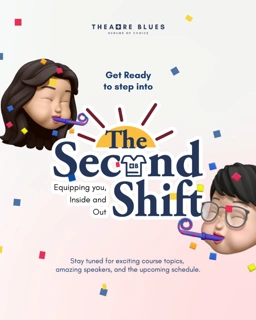
On our 5th anniversary, Theatre Blues introduced a bold new initiative, “The Second Shift”, which was created out of gratitude. Over the years, we received tremendous support from many people, and as a way of expressing gratitude, Theatre Blues sought to extend that same support to others. Through this opportunity, our team wants to help many people grow more deeply by creating a space to grow, rest, and dream. To celebrate this milestone, The Second Shift was held on October 31, 2025, and November 7, 2025, with almost a hundred participants taking part in this celebration. Everything begins with small steps, yet when those small steps are taken with sincerity and dedication, they transform into meaningful achievements and become a stepping stone toward our dreams. These small steps are expected to grow into valuable lessons, sources of support, and meaningful connections, which make the journey ahead clearer and more accessible. We hopes that this initiative will inspire everyone to be more confident in taking the first step to embrace growth and dare to dream higher💭
What non-medical skills should healthcare professionals know? 🤔❓
At The Second Shift, we explored this further🧭.
So, stay tuned!🤩
Some people might wonder, “Do healthcare professionals really need to know how to use Microsoft Excel? Isn’t our job just to treat patients?” The answer is clear: “YES, they absolutely do!”🙌🏻
Many healthcare professionals are still unfamiliar with tools like Microsoft Excel, even though it can significantly support administrative data management. When people ask, “What kind of administrative data do healthcare professionals even handle?” the answer is simple, “daily duty schedules”. Beyond that, Microsoft Excel can also be used to recap patient data, compile research reports, manage personal budgeting, and track savings and income. Another common perception is “Using Microsoft Excel is complicated—why not just write things down the usual way 📝or we can take notes on our phone📱?” This is exactly the mindset that needs to change. Once you understand the basics, Excel becomes a powerful tool that simplifies your tasks, improves efficiency, and saves time.⏰
Excel 101 📊 begins with mastering the basic skills, such as building clean and consistent tables, ensuring each column serves a single purpose, avoiding merged cells, freezing key information so it remains visible, and maintaining neat formatting. Well-organized data will help you see the bigger picture clearly. Always start with a question: define what you want to solve and identify the information that you need. Then design your table accordingly and use formulas to connect data logically, just as symptoms guide a diagnosis. Finally, visualize with purpose so we can present data side by side for comparison, highlight the key points with intentional color, and keep visuals clean so the data can speak for itself. Through Excel 101 📊, Andrew Kasuma shared a meaningful impact with all of us by encouraging smart work over hard work. He is an Operating Excellence professional in a logistics company who uses Excel not merely as a program, but as a partner in problem-solving. He has also been invited to various events to share his expertise in advanced data processing using Excel. This small step was designed to help make life more efficient, enable faster adaptation, and support better decision-making. Together, we can prove that even a simple skill can create lasting change.
Besides refining skills, we also need a simple CV 📑as an essential requirement when applying for a job, entering a specialty program, or pursuing a scholarship. But how can we make our CV efficient, concise, and straight to the point without being overly wordy? The Second Shift provided a solution. Especially for medical students, having a strong CV is a priority. Many aspire to showcase their experiences, such as competitions, committee roles, symposium participation, as well as various academic and organizational activities. However, the way a CV is structured can make a significant difference. Even something that seems simple can create a lasting impact on your future opportunities. What truly matters is presenting your achievements in a practical and straightforward way, enhanced with thoughtful details that make them stand out. To make it effective, keep it clear and impactful, limit it to 2-5 pages, prioritize recent and relevant experience, use a clean font, and present measurable results rather than just listing activities. Include key elements such as personal details, education, publications, and professional experiences, and strengthen it with organizational roles, skills, and training that set you apart. On this occasion, dr. Patricia Angel guided us on how to craft CV 📄 that opens doors, ensuring it is simple yet compelling. She is an accomplished doctor and content creator who shares effective strategies on how to craft a CV into a compelling document that is not only attractive to others, but also meaningful and impressive to ourselves and now she is currently pursuing a master’s degree at a prestigious university abroad. Through her session, we learned that clarity, structure, and intentional presentation can turn an ordinary CV into a powerful opportunity opener🍀
After refining our skills and crafting a strong CV, managing your finances 💸 becomes equally important. The responsibilities we face after graduation are never easy because entering the professional world requires constant adaptation. Although working provides us with income, as human beings we naturally have goals, desires, and needs we want to fulfill once we begin earning. At the Second Shift, dr. Jeptah Furano Lumban Tobing, B.MedSc(Hons), Sp.OT(K), shared valuable insights on managing personal finances wisely through “Financial 101 for Doctors💸🩺”. He emphasized that when we master small, disciplined financial habits, our lives become more stable and peaceful, allowing healthcare professionals to focus on what truly matters: serving the community. We must track expenses, separate needs from wants using the 50-30-20 principle, and build an emergency fund of at least six months’ income. In this session, we highlighted the need for proper protection through health, life, and malpractice insurance, as well as starting investments early while avoiding uncontrolled lifestyle spending driven by FOMO🤭.
Healthcare professionals are not only expected to be knowledgeable about health but also financially literate. No matter how large the income, without proper management, it can easily disappear without meaningful impact. dr. Jeptah Furano is an orthopedic specialist with a BMedSc degree from Monash University (Melbourne) and the founder of @dissectingmoney. Through his extensive experience, he shares numerous practical tips and tricks to help people understand finance in a simple and accessible way especially for those who are not yet financially literate or who may not fully realize the importance of financial knowledge. We were reminded that financial awareness is not separate from our profession, but it is part of building a sustainable and responsible future🔮
The Second Shift not only shared knowledge and experience but also created meaningful opportunities. During the event, five fortunate participants were selected simply by actively participating and submitting an essay through a Google Form. In celebration of our 5th anniversary🎂, we awarded five fully funded tickets covering registration fees for ACLS, ATLS, or a symposium in support of those who are eager to grow and develop themselves, in line with the core mission of The Second Shift. Congratulations to the winners🎉🥳, may this opportunity bring lasting benefit to your journey ahead!♥️
From beginning to end, The Second Shift offered valuable lessons, reminding us that growth begins with a small step, that learning transforms uncertainty into understanding, and that anything becomes possible when we are willing to strive and persevere✨